Category: Announcements
October 19th, 2015 by pio@shoreline.edu

Join Counseling Services for an interactive workshop: Understanding Depression on Wed., Oct. 21 at 12:30 p.m. in the PUB 9202.
Everyone occasionally feels blue or sad. But these feelings are usually short-lived and pass within a couple of days. When you have depression, it interferes with daily life and causes pain for both you and those who care about you.
Join Counseling Services at our interactive workshop and learn more about how to recognize the signs and symptoms of depression for yourself or someone you care about.
Questions about the workshop? Contact Sheryl Copeland at scopeland@shoreline.edu or 206.533.6712.
Want to know more about depression? Visit HelpGuide.org.
Need someone to talk to? Stop by Counseling Services in FOSS 5229 or call us at 206.546.4559 to schedule an appointment with a professional counselor.
Need 24/7 Crisis Support?
King County Crisis Line | 1-866-427-4747 | TTY: 206-461-3219
Snohomish County Crisis Line | 1-800-584-3578 | Online Chat: carecrisischat.org
Posted in Announcements, Events, Free, Services for Students, Workshops Tagged with: counseling services, depression
October 19th, 2015 by pio@shoreline.edu
Dear Members of the Campus Community,
The first meeting of the College Council for Fall quarter will be held on Tues., Oct. 20, 2015 at 3:15 p.m. in the Board Room (#1010M).
To access the College Council’s site on the intranet, click: http://intranetnew.shoreline.edu/college-council/
Thank you,
-Ashley Cowan, ASG President & 2015-2016 College Council Chair
-Cheryl Roberts, President
Posted in Announcements, ASG, Events Tagged with: college council
October 19th, 2015 by pio@shoreline.edu
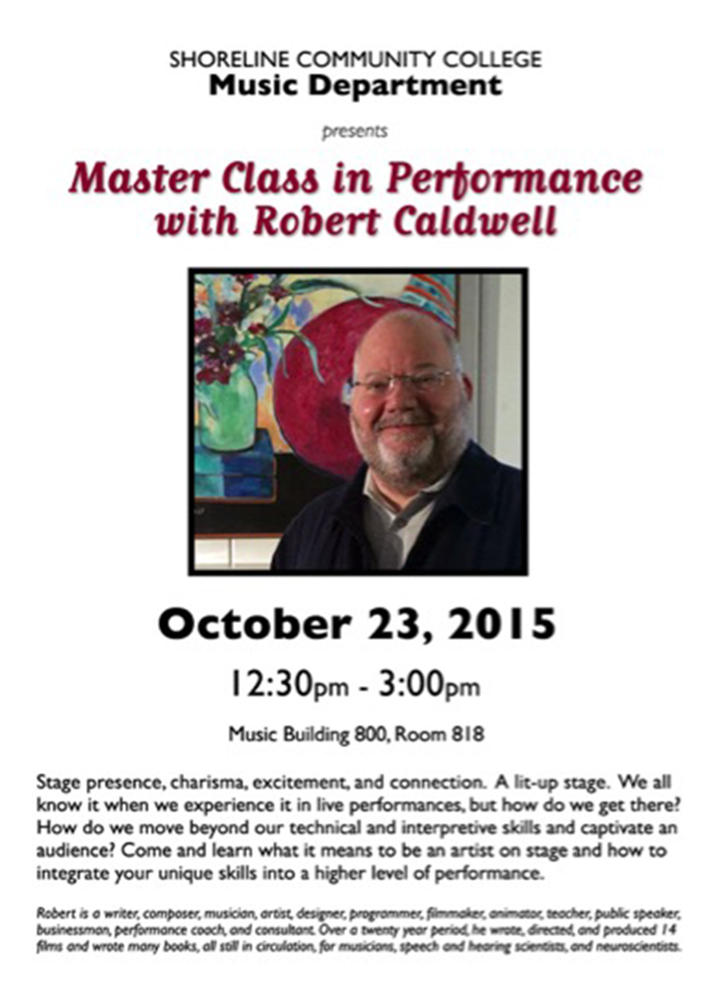 Join the music department this Fri., Oct. 23 for a Master Class in Performance with guest speaker Robert Caldwell from 12:30-3 p.m. in the Music Building, room 818. Free and open to the entire campus community and public.
Caldwell will talk about what it takes to be a performer.
Stage presence, charisma, excitement, connection — A lit-up stage—we all know it when we
experience it in live performances. But how do we get there? How do we move beyond our technical and interpretive skills and captivate an audience? Do magical performances happen to only “born performers”?
What if “born performers” have simply happened to put together their internal worlds in a way that anyone can learn? In other words, what if such intangibles as stage presence were a matter of skill? Come explore the question of what it means to be an artist on stage, of how to integrate technical and interpretive skills into a higher level of performance.
Come to learn platform skills, skills to find your way to brilliance on stage, and even those internal skills common to performers rarely discussed. Come to heighten your passion for your art.
Mr. Caldwell, will work with four Shoreline Community College students. Please join us in this wonderful opportunity offered through the Shoreline Community College Music department.
Robert Caldwell
Robert is a writer, composer, musician, artist, designer, programmer, filmmaker, animator, teacher, public speaker, businessman, performance coach, and consultant. Over a twenty-year period, he wrote, directed, and produced 14 films and wrote many books, all still in circulation, for musicians, speech and hearing scientists and neuroscientists.
His story begins at the age of 17. His travels, education and experiences led him to wonder why some people light up an audience while others don’t, given that they might play the same music at high levels of competence. He wanted to understand the underlying fundamentals of lighting up a heart and mind, and why such a thing as performances exist at all in our species. Following this quest, which led him through all facets of human expression—music, literature, art, architecture, design, computer programming, for instance—combined with his keen interest in both art and science, especially, neuroscience, he wrote his first book on performance at age twenty-seven. He has continued to actively develop these ideas into a pragmatic philosophy and collection of techniques, coaching performers of all levels, from beginners to international stars.
His works include:
Diction for Singers; The Performer Prepares; The Singer’s Voice: Breath, Vocal Folds, Vocal Tract, Resonance, and The Human Voice animation/visualization film series; Singers’ Edition, Guide to Operatic Roles and Arias Light Lyric Soprano and Soubrette, and Guide to Operatic Duets; The five volumes of Excellence in Singing: Beginning the Process, Mastering the Fundamentals, Advancing the Technique, Becoming an Artist, and Managing Vocal Health; Human Speech Science: Acoustics, Articulation, and The Source-Filter Theory, and Through a Portal to the Mind.
Posted in Announcements, Arts & Entertainment, Events, Free, Workshops Tagged with: music department
October 18th, 2015 by pio@shoreline.edu

In honor of Disability Employment Awareness Month, the Office of Special Services (OSS) is working to raise awareness of disabilities by offering daily facts and tips about people with disabilities and living with disability. Please take a minute to read and broaden your understanding.
“All learning has an emotional base.” — Plato
The ability to express and control our emotions is essential, but so is our ability to understand, interpret, and respond to the emotions of others. Imagine a world where you could not understand when a friend was feeling sad or when a co-worker was angry. Psychologists refer to this ability as emotional intelligence, and some experts even suggest that it can be more important than IQ.
Learn more about exactly what emotional intelligence is, how it works, and how it is measured.
What is Emotional Intelligence?
Emotional intelligence (EI) refers to the ability to perceive, control and evaluate emotions. Some researchers suggest that emotional intelligence can be learned and strengthened, while others claim it is an inborn characteristic.
The Four Branches of Emotional Intelligence
Salovey and Mayer proposed a model that identified four different factors of emotional intelligence: the perception of emotion, the ability reason using emotions, the ability to understand emotion and the ability to manage emotions.
- Perceiving Emotions: The first step in understanding emotions is to perceive them accurately. In many cases, this might involve understanding nonverbal signals such as body language and facial expressions.
- Reasoning With Emotions: The next step involves using emotions to promote thinking and cognitive activity. Emotions help prioritize what we pay attention and react to; we respond emotionally to things that garner our attention.
- Understanding Emotions: The emotions that we perceive can carry a wide variety of meanings. If someone is expressing angry emotions, the observer must interpret the cause of their anger and what it might mean. For example, if your boss is acting angry, it might mean that he is dissatisfied with your work; or it could be because he got a speeding ticket on his way to work that morning or that he’s been fighting with his wife.
- Managing Emotions: The ability to manage emotions effectively is a crucial part of emotional intelligence. Regulating emotions, responding appropriately and responding to the emotions of others are all important aspect of emotional management.
According to Salovey and Mayer, the four branches of their model are, “arranged from more basic psychological processes to higher, more psychologically integrated processes. For example, the lowest level branch concerns the (relatively) simple abilities of perceiving and expressing emotion. In contrast, the highest level branch concerns the conscious, reflective regulation of emotion” (1997).
A Brief History of Emotional Intelligence
- 1930s – Edward Thorndike describes the concept of “social intelligence” as the ability to get along with other people.
- 1940s – David Wechsler suggests that affective components of intelligence may be essential to success in life.
- 1950s – Humanistic psychologists such as Abraham Maslow describe how people can build emotional strength.
- 1975 – Howard Gardner publishes The Shattered Mind, which introduces the concept of multiple intelligences.
- 1985 – Wayne Payne introduces the term emotional intelligence in his doctoral dissertation entitled “A study of emotion: developing emotional intelligence; self-integration; relating to fear, pain and desire (theory, structure of reality, problem-solving, contraction/expansion, tuning in/coming out/letting go).”
- 1987 – In an article published in Mensa Magazine, Keith Beasley uses the term “emotional quotient.” Some suggest that this is the first published use of the phrase, although Reuven Bar-On claims to have used the term in an unpublished version of his graduate thesis.
- 1990 – Psychologists Peter Salovey and John Mayer publish their landmark article, “Emotional Intelligence,” in the journal Imagination, Cognition, and Personality.
- 1995 – The concept of emotional intelligence is popularized after publication of psychologist and New York Times science writer Daniel Goleman’s book Emotional Intelligence: Why It Can Matter More Than IQ.
Measuring Emotional Intelligence
“In regard to measuring emotional intelligence – I am a great believer that criterion-report (that is, ability testing) is the only adequate method to employ. Intelligence is an ability, and is directly measured only by having people answer questions and evaluating the correctness of those answers.” –John D. Mayer
- Reuven Bar-On’s EQ-i
A self-report test designed to measure competencies including awareness, stress tolerance, problem-solving, and happiness. According to Bar-On, “Emotional intelligence is an array of noncognitive capabilities, competencies, and skills that influence one’s ability to succeed in coping with environmental demands and pressures.”
- Multifactor Emotional Intelligence Scale (MEIS)
An ability-based test in which test-takers perform tasks designed to assess their ability to perceive, identify, understand, and utilize emotions.
- Seligman Attributional Style Questionnaire (SASQ)
Originally designed as a screening test for the life insurance company Metropolitan Life, the SASQ measures optimism and pessimism.
- Emotional Competence Inventory (ECI)
Based on an older instrument known as the Self-Assessment Questionnaire, the ECI involves having people who know the individual offer ratings of that person’s abilities in several different emotional competencies.
The above information and more can be found here.
Posted in Announcements Tagged with: disability awareness month, OSS
October 18th, 2015 by pio@shoreline.edu

Want expert help filling out your FAFSA? Come to our free workshop Mon., Oct. 19 from 2:30-4 p.m. in the Workforce Education Computer Lab in FOSS 5101. Bring your tax information or estimates, including parents’ tax information if applicable.
Members of Shoreline’s Enrollment & Financial Aid Services office will be on hand to help you get started and complete the free application for federal student aid (FAFSA).
.
Posted in Announcements, Free, Services for Students, Workshops Tagged with: fafsa
October 18th, 2015 by pio@shoreline.edu
On Mon., Oct. 19 from 11 a.m. – 1 p.m. college representatives from UW Bothell will be in the PUB to meet with interested students. Reps will discuss topics such as academic programs, campus life, financial aid and admission procedures for their college. They can answer any other questions students may have.
Posted in Announcements Tagged with: college rep, uw bothell
October 16th, 2015 by pio@shoreline.edu
In honor of Disability Employment Awareness Month, the Office of Special Services (OSS) is working to raise awareness of disabilities by offering daily facts and tips about people with disabilities and living with disability. Please take a minute to read and broaden your understanding.
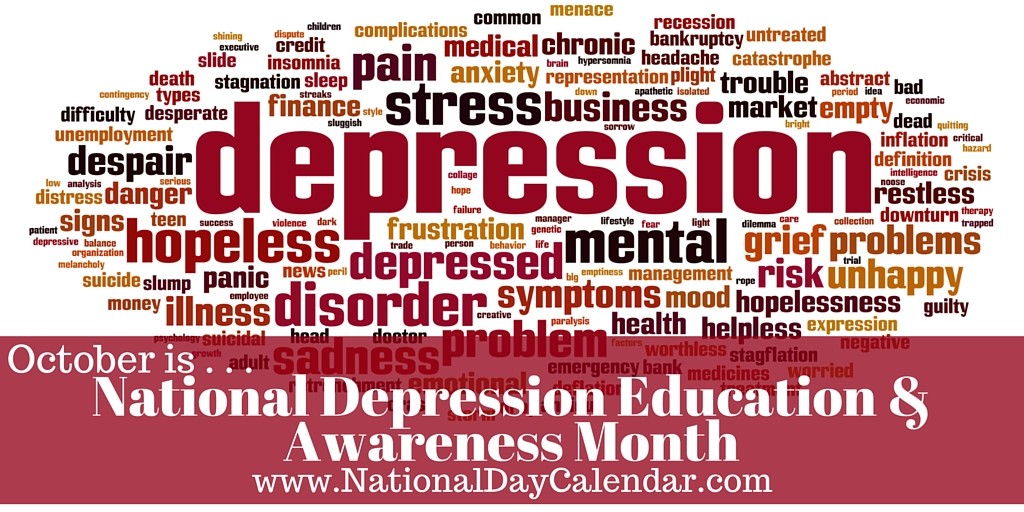
October is National Depression Education & Awareness Month!
October is National Depression Education and Awareness Month, and it’s the perfect time to shine a light on what has been called “the common cold” of mental illness. Depression affects more than 19 million Americans each year. This figure includes the following types of depression:
- Major depressive disorder (also called major depression or clinical depression)
- Manic depression (called bipolar disorder)
- Dysthymia (a milder, but long-term type of depression)
How Does Depression Affect A Person?
Have you ever heard someone remark casually, “Oh, I’m so depressed….”? They may be referring to something other than depression. Depression is not the same as feeling sad or blue. It is not grief, although someone who is grieving may experience it while they mourn a loss.
Depression is a medical condition that has an impact on a person’s daily life. It interferes with someone’s ability to eat, sleep, work and even concentrate. Depression robs sufferers of their ability to engage in hobbies and activities that they previously enjoyed.
Signs And Symptoms Of Depression
Just about everyone has thought or felt one or more of the following signs and symptoms of depression from time to time. If several of the signs on this list seem familiar to you or about someone you love and are persistent, please seek help from a physician. If you are having thoughts about self-harm, go to your nearest Emergency Room immediately.
- Feeling sad, anxious or “empty”
- Irritability or restlessness
- Hopelessness or pessimism
- Feeling guilty or worthless
- Lack of interest or pleasure in former hobbies or interests
- Fatigue or lack of energy
- Trouble concentrating, remembering or making decisions
- Trouble getting to sleep or staying asleep
- Lack of appetite or overeating
- Headaches, digestive disorders or chronic pain that does not respond to treatment
- Suicidal thoughts
Self-Medicating Depression
Self-medicating is never a good idea to “treat” depression. Some people, in an effort to feel better, turn to drugs or alcohol to deal with their symptoms. This will not help to treat the underlying problem, and usually make it worse.
Treatment Options For Depression
The good news is that depression is treatable. There are several types of antidepressant medications available, though it does take several weeks to determine whether a particular medication is working. Patients who have been prescribed a medication are advised to be patient and to give the medicine some time before concluding that it is not helping before asking to switch to something else.
Talk therapy is also used to treat depression and it can be started immediately upon receiving a diagnosis (as long as a therapist can be found). There are no side effects and individual results will vary.
Many people report getting good results with a combination of medication and seeing a therapist for their depression.
The above information and more can be found at www.marylandrecovery.com.
Want to learn more about depression? Here are 10 basic facts:
- Approximately 20 million people in the U.S. suffer from depression every year. That’s more than twice the population of New York City.
- One in four adults will suffer from an episode of depression before the age of 24.
- Women are twice as likely to suffer from depression as men.
- Symptoms of depression can vary, but typically include feelings of guilt and hopelessness, sleep disturbances, appetite changes, difficulty concentrating, lack of energy and fatigue.
- St. John’s Wort, a flowering plant and medicinal herb, has been shown to help with depression in typical cases.
- More than 350 million people of all ages suffer from depression worldwide. That’s more than the entire population of the United States.
- The World Health Organization predicted depression will become the second biggest medical cause of disability in 15 years, second only to HIV/AIDS.
- Depression often occurs when other psychiatric health problems are present, such as post-traumatic stress disorder and anxiety.
- Most prescription antidepressants increase the user’s serotonin, dopamine or norepinephrine levels. Some of the most popular antidepressants are Prozac, Zoloft, Lexapro and Effexor.
- Many famous, creative people suffered from depression, including Robin Williams, Mark Twain, Edgar Allan Poe, Vincent van Gogh, F. Scott Fitzgerald and Jon Hamm.
This list, as well as additional information, can be found at www.ibtimes.com.
Posted in Announcements Tagged with: disability awareness month, OSS
October 15th, 2015 by pio@shoreline.edu

Are you planning to transfer to the University of Washington? Join us for an online UW Admissions and Transfer Planning session Tues., Oct. 20 at 2 p.m. Students attending this completely online session will learn about:
- admission requirements
- application process
- preparing for a major
- and how to connect with UW resources
To RSVP for this event, please e-mail jlee@shoreline.edu. You will receive a confirmation e-mail with a website link to enter the online session.
Posted in Announcements, Free, Workshops Tagged with: transfer students, uw
October 15th, 2015 by pio@shoreline.edu

The Shoreline Athletic Department welcomes all students, faculty, staff and alumni to “Pack the Stands for the Green & Gold” at our Volleyball Spirit Day on Wed., Nov. 4 at 7 p.m. We will be honoring past athletic alumni as well as the current Volleyball Sophomore class.
Come out and “Catch the Wave of the Green & Gold”!
Athletic alumni please RSVP to athletics@shoreline.edu if you will be joining us for the celebration!
Posted in Announcements, Athletics, Events, Free Tagged with: pack the stands, spirit day
October 15th, 2015 by pio@shoreline.edu

Join us in the main campus theater (1600 bldg) this Sat., Oct. 17 at 7:30 p.m. for an evening of student filmmaking at its finest – the Shoreline Shorts Film Festival!
Like nothing you’ve seen before because this is an evening of student written, directed and acted short films; some gritty, some funny, some poignant, but all original.
This event is free and open to the public.
Posted in Announcements, Arts & Entertainment, Events, Free Tagged with: shoreline shorts, student films
